Certification Overview
About this Certification
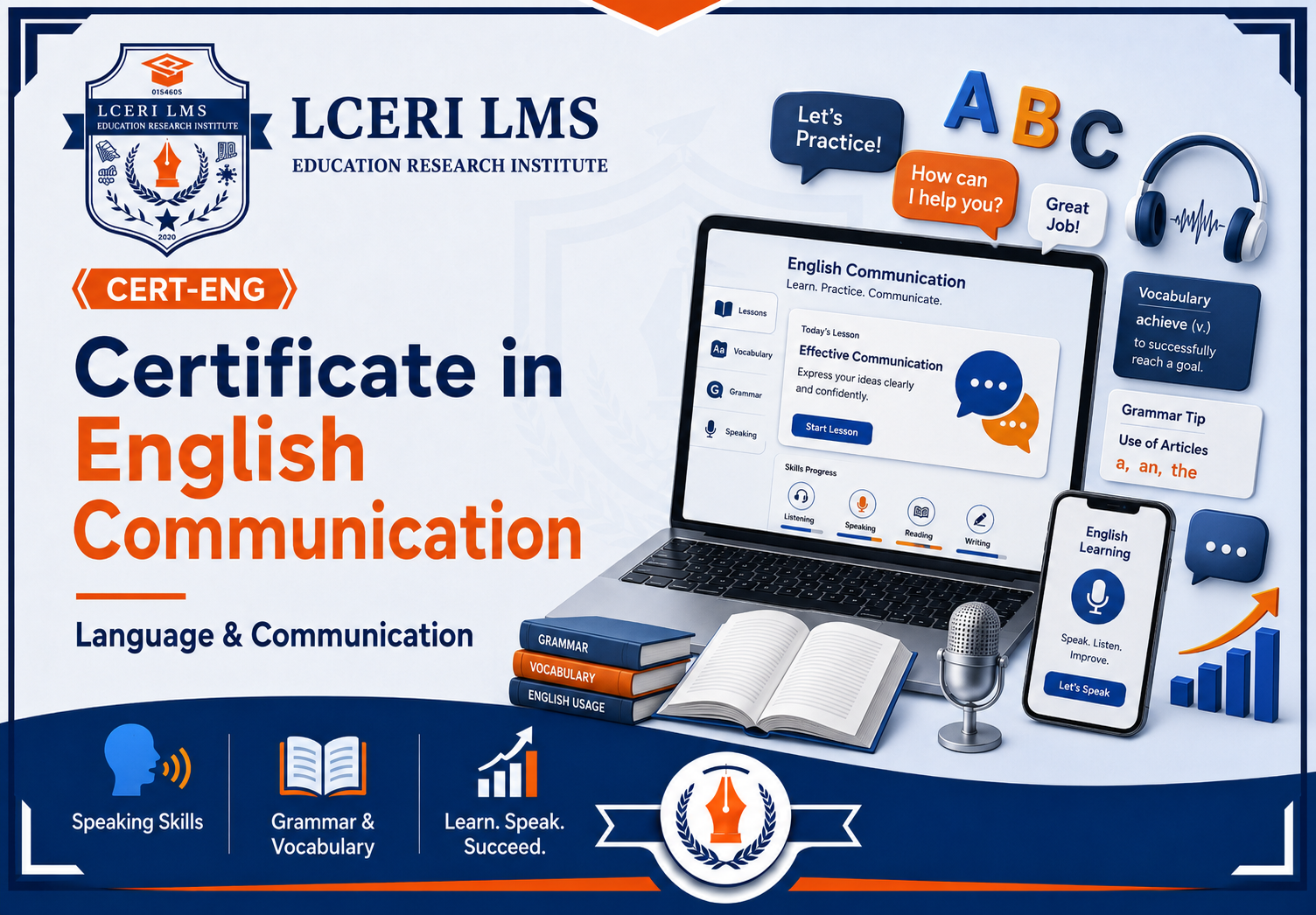
The Professional Certification in English Language is designed to improve learners’ ability to communicate accurately, confidently, and effectively in academic, professional, and everyday situations.
The certification covers the four essential language skills: listening, speaking, reading, and writing. Learners will also develop a stronger understanding of English grammar, sentence structure, vocabulary, pronunciation, punctuation, and commonly used expressions.
Participants will practise introducing themselves, taking part in conversations, asking and answering questions, giving opinions, delivering short presentations, reading different types of texts, and writing clear messages, emails, paragraphs, reports, and formal documents.
The programme also focuses on practical communication for education and the workplace. Learners will develop skills in interview communication, public speaking, presentation delivery, email writing, telephone conversations, meeting participation, and professional correspondence.
Pronunciation activities will help participants improve clarity, word stress, sentence stress, rhythm, intonation, and confidence while speaking. Grammar and vocabulary will be taught through practical examples rather than isolated rules.
Through guided lessons, listening activities, speaking exercises, reading tasks, writing assignments, quizzes, and a final language project, learners will develop balanced English language proficiency.
Upon successful completion, participants should be able to:
Communicate confidently in common social, academic, and professional situations.
Understand spoken English in conversations, instructions, presentations, and recorded material.
Use correct grammar and sentence structure in speech and writing.
Expand and apply practical English vocabulary.
Improve pronunciation, word stress, intonation, and speaking clarity.
Read and understand general, academic, and workplace texts.
Write clear paragraphs, emails, applications, reports, and formal messages.
Participate effectively in discussions, interviews, meetings, and presentations.
Express ideas, opinions, experiences, and arguments in an organised manner.
Identify and correct common grammatical and communication errors.
Apply appropriate tone, vocabulary, and language style for different audiences.
Demonstrate improved overall English language proficiency through a final assessment.
The certification covers the four essential language skills: listening, speaking, reading, and writing. Learners will also develop a stronger understanding of English grammar, sentence structure, vocabulary, pronunciation, punctuation, and commonly used expressions.
Participants will practise introducing themselves, taking part in conversations, asking and answering questions, giving opinions, delivering short presentations, reading different types of texts, and writing clear messages, emails, paragraphs, reports, and formal documents.
The programme also focuses on practical communication for education and the workplace. Learners will develop skills in interview communication, public speaking, presentation delivery, email writing, telephone conversations, meeting participation, and professional correspondence.
Pronunciation activities will help participants improve clarity, word stress, sentence stress, rhythm, intonation, and confidence while speaking. Grammar and vocabulary will be taught through practical examples rather than isolated rules.
Through guided lessons, listening activities, speaking exercises, reading tasks, writing assignments, quizzes, and a final language project, learners will develop balanced English language proficiency.
Upon successful completion, participants should be able to:
Communicate confidently in common social, academic, and professional situations.
Understand spoken English in conversations, instructions, presentations, and recorded material.
Use correct grammar and sentence structure in speech and writing.
Expand and apply practical English vocabulary.
Improve pronunciation, word stress, intonation, and speaking clarity.
Read and understand general, academic, and workplace texts.
Write clear paragraphs, emails, applications, reports, and formal messages.
Participate effectively in discussions, interviews, meetings, and presentations.
Express ideas, opinions, experiences, and arguments in an organised manner.
Identify and correct common grammatical and communication errors.
Apply appropriate tone, vocabulary, and language style for different audiences.
Demonstrate improved overall English language proficiency through a final assessment.
